






As researchers move beyond traditional cosmetic ingredients in search of molecules with greater structural precision and targeted bioactivity, the importance of peptide research in modern skincare development has become increasingly evident. Recent studies focus not only on peptide functionality but also on optimizing molecular structure, stability, delivery characteristics, and formulation compatibility to enhance their practical utility.
This shift is particularly relevant to anti-aging research. Skin aging involves various biological processes, including changes to the extracellular matrix, the degradation of collagen and elastin, oxidative stress, and the gradual appearance of expression lines. Given their ability to interact with biological pathways in diverse ways, peptides-such as signal peptides, carrier peptides, enzyme-inhibiting peptides, and neurotransmitter-related peptides-are being explored as tools for cosmetic innovation. Published systematic reviews and meta-analyses, which included 19 randomized controlled trials, found that peptide-based interventions were associated with improvements in several skin aging markers-such as hydration and radiance-though results regarding elasticity were less consistent. Researchers also emphasize the need for further standardized studies, noting the wide variation in peptide types, dosages, formulations, and evaluation methods. Against this backdrop, the development of more stable and precisely engineered synthetic peptides is emerging as a key trend in the skincare ingredient industry.

Why has peptide stability become a research priority?
One challenge facing cosmetic peptides is that bioactivity alone does not determine an ingredient's efficacy in the final formulation. Factors such as molecular size, chemical stability, skin permeability, degradation, and compatibility with other formulation ingredients all influence actual performance.
The skin itself acts as a significant barrier; the outermost layer-the stratum corneum-limits the penetration of many peptide molecules. Consequently, researchers are exploring structural modifications, delivery systems, and formulation strategies designed to enhance peptide stability and bioavailability. Recent reviews indicate that structural optimization and delivery technologies represent the two primary directions in skincare peptide research.

Research is also moving toward a more systematic approach to peptide discovery. Scientists are increasingly utilizing molecular modeling, sequence analysis, computational prediction, and other methods to identify peptide structures capable of interacting with specific biological targets, rather than relying solely on traditional screening techniques. A recent review on bioactive peptide research highlights the increasingly important role of computational methods in identifying candidate peptides for skin regeneration and extracellular matrix studies.
This approach has transformed the perception of cosmetic peptides. Researchers no longer view peptides merely as another category of skincare ingredients; instead, they can design molecules based on specific structural and functional characteristics.
This shift also presents practical considerations for manufacturers and ingredient developers. Can peptides retain their intended properties during storage? Can they be incorporated into creams, serums, lotions, or other delivery systems? Can consistent quality be maintained across batches? These questions have become increasingly critical as peptide-based formulations transition from laboratory research to commercial product development.
Application of Biomimetic Peptides in Anti-Aging Research
Biomimetic peptides exemplify this design philosophy. These synthetic molecules are engineered to replicate or mimic the specific properties of natural biological peptides, while allowing researchers to control molecular structure and production.
One notable area of research involves synthetic peptides inspired by molecules derived from venom. While natural venom peptides may possess highly specific biological activities, the direct use of naturally sourced molecules can pose challenges regarding production, consistency, stability, and formulation. Synthetic peptide chemistry offers an alternative method to replicate specific structural features under controlled production conditions.
This concept is exemplified by Syn-Ake peptide powder; the INCI name for its active ingredient is Dipeptide Diaminobutyroyl Benzylamide Diacetate. This ingredient is a synthetic peptide designed based on the functional characteristics of Waglerin-1, a peptide associated with the venom of the Temple Viper. Manufacturers describe the commercial ingredient Syn-Ake as a small-molecule synthetic peptide designed based on biomimetic principles.
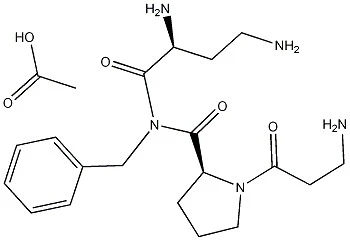
From a research perspective, its significance lies not only in its source of inspiration but also in the ability to translate biological concepts into synthetic molecules with well-defined structures. This links the ingredient closely to skincare mechanisms involving neurotransmitters and the formation of expression lines.
Existing scientific literature has examined Syn-Ake-related peptides in the context of acetylcholine receptor activity and facial muscle movement, while also highlighting the need for further research to establish their efficacy and safety in cosmetic applications.
For ingredient developers, synthetic production offers numerous practical advantages. A defined molecular structure facilitates analytical characterization and batch-to-batch quality control, and synthetic production is not directly affected by supply fluctuations of natural biological raw materials. This is particularly important for developing high-purity cosmetic ingredients. Researchers and manufacturers must consider not only the biological functions of peptides but also their physicochemical properties, purity, stability, formulation compatibility, and relevant quality standards.
What form will the next generation of peptide-based skincare products take?
The next phase of research into peptide skincare products will likely result from a combination of molecular design and formulation science, rather than relying solely on a single breakthrough ingredient.
Researchers are working to improve peptide delivery efficiency through advanced formulations and carrier systems. Recent studies have explored engineered peptide delivery platforms aimed at addressing challenges such as enzymatic degradation and limited transdermal permeability.
Meanwhile, a body of evidence is steadily accumulating. A systematic review of clinical trials indicates that peptides can influence measurable markers of skin aging, though it also highlights significant variations across different studies. Consequently, conducting more standardized research is crucial to identifying which peptide structures, concentrations, delivery routes, and formulation strategies yield reproducible efficacy.

For the cosmetic ingredient industry, this creates opportunities for ingredients that offer clearly defined molecular structures, high purity, stability, and formulation flexibility. For laboratories and manufacturers developing next-generation skincare products, the importance of peptide powders-capable of being characterized and utilized across various research and formulation systems-will become increasingly apparent. As a synthetic biomimetic peptide material derived from natural peptide mechanisms, Syn-Ake peptide powder aligns naturally with this broader research trend. Its value lies in the integration of peptide chemistry, receptor research, and anti-aging cosmetic development, rather than a reliance on natural sources alone.
As peptide science advances, the research focus is shifting from the fundamental question of whether peptides can support anti-aging applications to more specific, in-depth topics: Which molecular structures are the most stable? How can delivery methods be optimized? Which biological targets are critical? And ultimately, how can high-potential candidate peptides be transformed into cosmetic ingredients with stable performance and well-defined characteristics?
These questions are driving the evolution of next-generation peptide research, fostering closer integration among molecular design, quality analysis, formulation technology, and biological research. For cosmetic ingredient developers and research laboratories, this trend signals broader opportunities for exploring specialty peptide materials in future skincare formulations.