






Unveiling the Chemistry Behind 24-Hour Relief
When spring flowers bloom or ragweed spreads across the fields in autumn, millions of people worldwide suffer from seasonal allergies. One of the most distressing symptoms involves the eyes: persistent itching, severe redness, a burning sensation, and accompanying swelling and tearing-a condition medically known as "allergic conjunctivitis." Seeking quick relief, allergy sufferers often rush to the pharmacy to purchase over-the-counter eye drops.
However, many users get trapped in a frustrating cycle: the drops may provide brief relief for an hour or two, only for the unbearable burning and itching to return with a vengeance.
Why do conventional eye drops often lose their effectiveness so quickly? The answer lies in a fascinating microscopic biological process, and a breakthrough active pharmaceutical ingredient (API)-olopatadine hydrochloride-holds the key to solving this problem.
"Tiny Water Balloons" in Your Eyes
To understand why allergies cause such intense eye itching, we need to look more closely at what happens on the eye's surface during an allergic reaction.
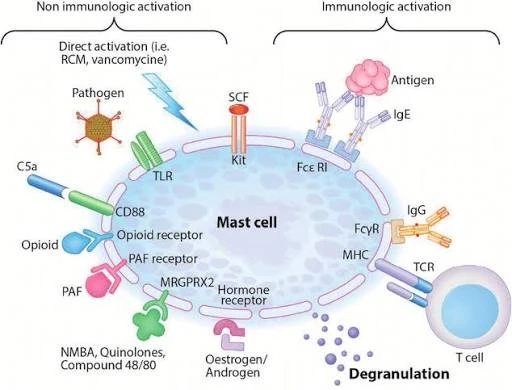
The conjunctiva-the thin, transparent membrane covering the white part of the eye-houses millions of specialized immune cells called "mast cells." Think of these mast cells as tiny "guards," each containing thousands of microscopic, high-pressure "water balloons." These "balloons" are filled with a natural chemical called histamine; when the body encounters a "threat," it releases histamine, triggering inflammation, swelling, and itching.
When airborne allergens-such as grass pollen, pet dander, or dust mites-land on the surface of the eye, they bind to receptors located on the surface of these mast cells. This interaction triggers a violent rupture of the cells-a biological process known as "degranulation." Within seconds, histamine floods the tissues around the eye, attaches to sensitive nerve endings, and sends a sharp, direct "Itch!" signal to the brain.
The Flaw in Traditional Approaches: "Cleaning Up" After the Fact
Why, then, do conventional eye drops often lose their effectiveness just hours after application?
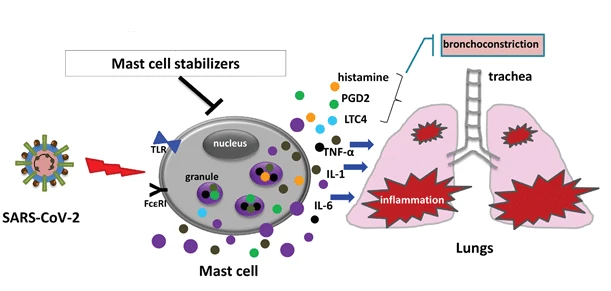
Most first-generation or basic antihistamine eye drops work like a mop and bucket. Once histamine is released into the ocular tissue, these basic drops block it from binding to nerve endings. While this provides temporary relief from itching, it does nothing to prevent mast cells from rupturing again.
As long as pollen remains in the air, mast cells keep bursting-like popping bubbles-and release fresh histamine into the eye. Basic eye drops quickly become overwhelmed, forcing users to apply them multiple times a day; this often leads to dry eyes, stinging, or persistent irritation.
A Dual-Action Approach: Blocking Receptors and Stabilizing Cell Membranes
This is precisely why Olopatadine Hydrochloride has fundamentally transformed the scientific approach to managing ocular allergies. As an advanced second-generation pharmaceutical compound, Olopatadine Hydrochloride provides a powerful "dual-action barrier," combating eye allergies from two directions simultaneously:
1. Olopatadine molecules rapidly bind to receptors on ocular nerve endings and blood vessels. This prevents histamine from attaching to these receptors, providing immediate relief from itching, burning, and redness.
2. Long-Lasting Protective Barrier (Mast Cell Stabilization): Unlike conventional medications, olopatadine strengthens and "seals" the outer membranes of mast cells. By regulating calcium ion influx at the cellular level, it prevents mast cells from rupturing at the source, effectively blocking histamine release-with effects lasting up to 24 hours.
Thanks to this dual mechanism of action, pharmaceutical companies have developed olopatadine hydrochloride (Olopatadine HCl) into convenient once- or twice-daily dosing regimens. These include 0.1% formulations for routine relief, 0.2% formulations for continuous, all-day protection, and high-concentration, ultra-long-acting 0.7% prescription formulations. These products give patients reliable, round-the-clock comfort without frequent application.
The Rise of Nasal Therapies and Combination Treatments
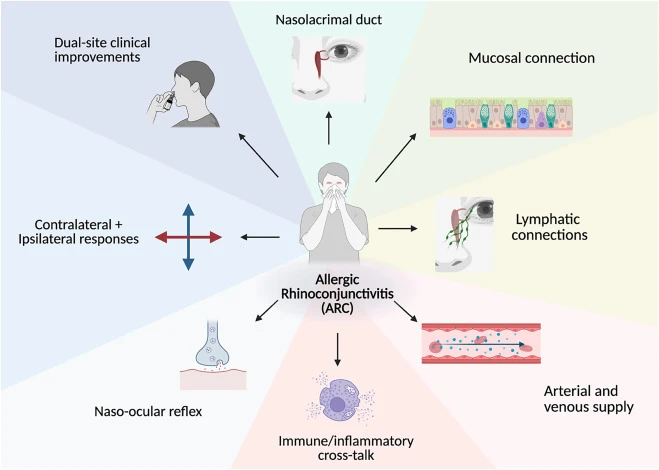
Although olopatadine hydrochloride (Olopatadine HCl) first gained recognition as a high-quality ophthalmic medication, modern pharmaceutical science has expanded its therapeutic applications well beyond eye drops. The ocular and nasal mucosal systems are closely linked via the nasolacrimal duct; consequently, seasonal allergic rhinitis often manifests with both itchy eyes and nasal congestion.
To address this interconnected mechanism, drug developers have increasingly incorporated olopatadine hydrochloride (0.6%) into specialized nasal spray suspensions. Once administered into the nasal cavity, the drug exerts a dual effect: it blocks local $H_1$ receptors and stabilizes mast cells within the nasal mucosa, effectively alleviating symptoms such as sneezing, runny nose, and nasal itching.
Furthermore, one of the fastest-growing trends in allergy medication is the development of fixed-dose combination (FDC) therapies. By combining olopatadine hydrochloride with a topical corticosteroid-such as mometasone furoate-into a single nasal spray, clinicians can offer patients a potent "two-pronged" defense: olopatadine hydrochloride provides rapid relief by blocking allergic symptoms within minutes. In contrast, the corticosteroid targets the underlying, long-term allergic inflammation in deeper tissues.
This formulation versatility has made high-purity olopatadine hydrochloride active pharmaceutical ingredient (API) a vital component for pharmaceutical companies-an asset of growing importance for firms looking to expand their product portfolios in respiratory and allergy treatment.
Requirements for Olopatadine Hydrochloride API
While patients may only care about waking up with clear, itch-free eyes, pharmaceutical engineers, formulation experts, and API procurement managers know that transforming this remarkable molecule into an effective finished drug product demands extreme precision regarding raw materials.
To ensure that eye drops or nasal sprays are gentle, stable, and clinically efficacious, the Olopatadine Hydrochloride API used must meet rigorous technical specifications:
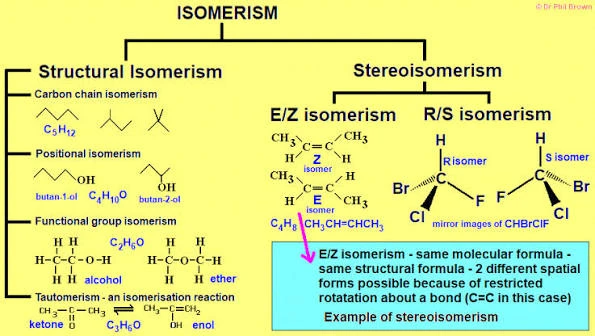
Strict Isomeric Purity: Olopatadine exists in different geometric isomers; however, only the pharmacologically active $(Z)$-isomer provides the desired dual therapeutic effect. During chemical synthesis, the inactive $(E)$-isomer-considered an impurity-must be strictly controlled to below 0.1% to ensure full potency and clinical safety.
Micronized Particle Size Distribution (PSD): In eye drops and nasal sprays, particle size is a Critical Quality Attribute (CQA). A micronized API with a uniform particle size distribution ensures rapid dissolution and prevents a gritty sensation or irritation to the ocular surface during use.
Compliance with Global Regulatory Requirements: A high-quality API must fully comply with international pharmacopeial standards and be supported by a comprehensive Drug Master File (DMF) to support smooth regulatory approval in healthcare markets worldwide.
Partnering to Supply High-Purity Olopatadine Hydrochloride API
With rising global pollen levels and the growing prevalence of environmental allergies, demand for highly effective, long-acting anti-allergy APIs continues to grow rapidly. Olopatadine Hydrochloride remains the industry's "gold standard" for treating ocular and nasal allergies.