




Cooling agents are widely used in everyday products, including toothpaste, skincare, pharmaceuticals, and food flavorings. For decades, menthol has been the most commonly used compound to produce a cooling sensation. However, as consumers increasingly demand gentler, longer-lasting, and less irritating ingredients, researchers and manufacturers are turning their attention to a new generation of menthol alternatives.
These new cooling compounds, often referred to as menthol derivatives or next-generation cooling agents, are attracting widespread attention across multiple industries. Scientists say these ingredients may provide the desired cooling sensation while offering greater stability, less irritation, and a longer-lasting effect.
Why replace traditional menthol?
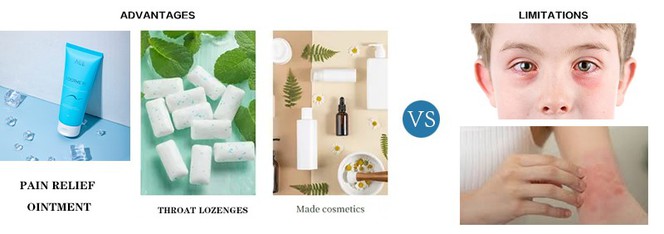
Menthol activates cold-sensitive receptors in the skin and mucous membranes, producing a cooling sensation without actually lowering body temperature. This effect makes it popular in products such as pain relief creams, throat lozenges, shampoos, and oral care products. However, menthol also has some limitations. At high concentrations, it can irritate the skin or eyes. Furthermore, its strong odor and high volatility cause it to evaporate quickly, resulting in a short-lasting cooling effect. In some formulations, the intense minty flavor of menthol can also negatively impact fragrance design or product flavor balance. Given these challenges, researchers have been developing menthol derivatives to minimize its drawbacks while maintaining its cooling effect.
Novel menthol alternatives are typically developed by altering menthol's chemical structure or by combining it with other molecules. These structural changes significantly alter the compound's properties-its evaporation rate, cooling intensity, and cooling duration.
According to industry researchers, L-monomenthyl glutarate offers a longer-lasting cooling effect than traditional menthol. It is also specially formulated to be less irritating to the skin and eyes, making it more suitable for use in products for sensitive skin, medical formulations, and leave-on cosmetics.
Another advantage is its stability. While traditional menthol evaporates rapidly upon contact with air or high temperatures, the newer cooling agent is chemically more stable, making it easier to use in complex formulations such as creams, gels, beverages, and functional foods. The growing interest in menthol alternatives extends beyond a single industry. In fact, demand is growing in multiple sectors:

Personal Care and Cosmetics: Cooling agents are commonly used in face masks, aftershaves, scalp care products, and anti-itch creams. New cooling compounds offer a gentle, long-lasting cooling sensation without the strong menthol odor, which is especially important for high-end skincare and fragrance-sensitive products.
Oral Care Products: Toothpaste and mouthwash manufacturers are exploring menthol alternatives to provide a cleansing, cooling sensation while avoiding excessive irritation, particularly suitable for people with sensitive gums or dry mouth.
Pharmaceuticals: Topical analgesics and anti-itch treatments often rely on cooling agents. Longer-lasting cooling ingredients can reduce the frequency of reapplication, thus improving patient comfort.
Food and Beverages: Cooling sensations are increasingly used in functional foods, chewing gum, and beverages. Some menthol alternatives provide a cooling effect without adding an overpowering mint flavor, allowing product developers to create entirely new flavor experiences.
Tobacco Alternatives and Other Consumer Products: Cooling agents are also used in some non-combustible consumer products where longer-lasting cooling and reduced irritation are important product characteristics.
Market Trends and Industry Focus: Market analysts report that global demand for cooling agents is steadily growing, driven by innovation in cosmetics, health supplements, and functional foods. Manufacturers are increasing their R&D investment to develop proprietary cooling compounds that provide unique sensory experiences. Industry experts say this trend is moving towards "functional sensory ingredients"-compounds that not only provide a cooling or warming sensation but also enhance product performance and user comfort. Furthermore, regulatory and safety considerations are prompting companies to develop ingredients with lower irritation and greater safety. Therefore, menthol alternatives, such as L-monomenthyl glutarate, are increasingly marketed as next-generation cooling solutions.

Shifting Consumer Preferences: Modern consumers are more ingredient-conscious than ever before. Many look at the ingredients listed on product labels, such as mild, low-irritant, or suitable for sensitive skin. This shift in consumer preferences is another reason why companies are investing in menthol alternatives.
The cooling sensation remains desirable-it's associated with cleansing, freshness, pain relief, and soothing comfort. The challenge for product developers is delivering this feeling in a pleasant, rather than overpowering, way.
New cooling compounds are designed to create what formulators call a "gentle coolness" or "delayed cooling." Unlike the instantaneous, intense coolness of menthol, these ingredients offer a gentler, longer-lasting, and more comfortable sensation.
Researchers believe that menthol alternatives like L-monomenthyl glutarate will continue to expand into new product categories over the next decade. Advances in chemistry and sensory science have enabled the design of cooling molecules with specific performance characteristics, such as sustained release, low odor, and controlled cooling intensity.
Some experts predict that in the future, product manufacturers will be able to "tailor" cooling sensations for different applications-a strong, fast-acting coolness for pain relief, a mild, long-lasting coolness for skincare, and a neutral coolness for food and beverages.
While menthol itself is unlikely to disappear, the market is clearly changing. New menthol-derived cooling agents are not simply replacements; they represent a new generation of functional ingredients designed to enhance user experience, product stability, and formulation flexibility. Cooling ingredients still play a vital role in many industries, from healthcare to cosmetics and food production. However, as technological advancements and changing consumer expectations advance, companies are increasingly seeking alternatives beyond traditional menthol.
New menthol compounds that offer a longer-lasting coolness with less irritation are attracting growing industry attention. As research progresses and more products adopt these new-generation cooling agents, consumers may soon experience a completely new kind of cooling sensation-gentler, more comfortable, and more effective than ever before.