




The compound is a naturally occurring flavonoid that has garnered increasing attention in neuroscience and pharmacology in recent years. Unlike many plant-derived flavonoids, which are primarily studied for their antioxidant properties, 7,8-DHF is notable for its potential influence on brain-derived neurotrophic factor (BDNF) signaling, neuronal survival, and synaptic plasticity. These biological processes are closely linked to learning, memory, and the maintenance of healthy neural connections.
One reason this compound has drawn particular interest from researchers is its purported interaction with tropomyosin receptor kinase B (TrkB)-a receptor involved in regulating several key pathways that govern neuronal function. Early experimental studies suggest that 7,8-DHF can replicate certain biological effects associated with BDNF, thereby opening new avenues for research into neuroprotection and brain health.
However, these potential benefits should be interpreted with caution. Most current findings are derived from laboratory experiments and animal models; therefore, questions remain regarding the exact mechanisms of action, pharmacokinetics, and clinical relevance to human health.
What are the potential benefits of 7,8-dihydroxyflavone
The primary research interest in 7,8-dihydroxyflavone (7,8-DHF) lies in its potential impact on neuronal function and brain-related biological processes, with attention focused on several key areas.
One significant area is neuroprotection. Neurons are constantly exposed to various biological challenges, including oxidative stress, inflammatory signaling, and shifts in cellular metabolism-factors that can lead to neuronal dysfunction and degeneration. Experimental studies have explored whether 7,8-DHF can influence cellular pathways associated with neuronal survival and resilience against damage.
A 2010 study reported that 7,8-DHF exhibits neuroprotective effects in experimental models. Researchers have observed a reduction in neuronal damage in models involving excitotoxicity, ischemic injury, and pathologies associated with Parkinson's disease. These findings help establish this compound as a potential candidate for further neuropharmacological research.
Another significant area of study concerns learning and memory. Synaptic plasticity refers to the ability of connections between neurons to strengthen or weaken based on activity; this process is fundamental to memory formation and information processing. Studies using animal models suggest that 7,8-dihydroxyflavone (7,8-DHF) may influence signaling pathways in the hippocampus that are linked to synaptic plasticity and memory function.
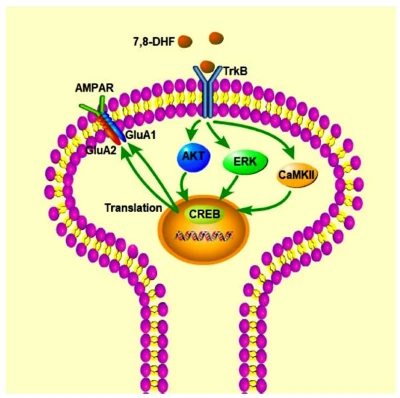
The hippocampus is particularly important, as it plays a central role in learning and memory. Experimental results indicate that the signaling changes associated with 7,8-DHF involve proteins engaged in neuronal communication, including CREB and components of the AMPA receptor system.
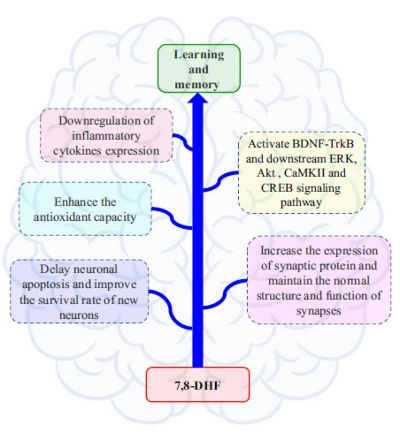
Researchers have also explored its potential connection to neurodegenerative diseases, such as Alzheimer's and Parkinson's. These studies generally focus on neuronal survival, oxidative stress, and neurotrophic signaling, rather than on established clinical therapeutic effects.
It is crucial to distinguish these research findings from proven benefits. While these results are scientifically significant, they do not demonstrate that 7,8-dihydroxyflavone (7,8-DHF) can improve memory, prevent neurodegenerative diseases, or treat neurological conditions in humans.
How does 7,8-dihydroxyflavone function in the brain
To understand the scientific interest in 7,8-DHF, it is necessary to examine the relationship between brain-derived neurotrophic factor (BDNF) and its receptor, TrkB.
BDNF is a neurotrophin that supports neuronal development, survival, differentiation, and synaptic function. When BDNF binds to TrkB, it activates various intracellular signaling pathways, including PI3K-AKT, MAPK-ERK, and PLC-γ. These pathways regulate neuronal growth, cell survival, and synaptic adaptation. Early research suggested that 7,8-dihydroxyflavone (7,8-DHF) might function as a small-molecule TrkB agonist. A 2010 study reported that this compound interacts with the extracellular domain of TrkB, stimulating receptor dimerization and phosphorylation. These events trigger downstream signaling responses that mimic some effects of brain-derived neurotrophic factor (BDNF).
Because BDNF itself has limitations as a potential therapeutic agent-such as delivery challenges and unfavorable pharmacokinetic properties-this mechanism has attracted significant attention.
However, this mechanism is not universally accepted. Subsequent biochemical and pharmacological studies have questioned whether 7,8-DHF can directly and reliably activate TrkB across various experimental conditions.
A notable 2021 study reported that TrkB-dependent activation by this compound is difficult to replicate. Furthermore, its limitations regarding pharmacokinetics and target selectivity have been noted. These findings suggest that certain biological effects attributed to 7,8-DHF may involve molecular targets other than selective TrkB activation.
Consequently, researchers should not characterize 7,8-DHF as a definitively proven substitute for BDNF, nor should it be regarded as an established, selective TrkB activator. Its mechanism of action remains an important subject of ongoing research.
What are the side effects and safety considerations associated with 7,8-DHF
Safety is a critical consideration when evaluating any experimental compound, particularly those being investigated for applications within the nervous system.
At present, there is insufficient evidence to establish the safety of pure 7,8-DHF in humans. Most existing research is based on cell cultures and animal models-findings that cannot fully predict how the compound will behave in the human body.
Interest in 7,8-DHF has also extended to research on attention, including investigations into its potential link to attention-deficit/hyperactivity disorder (ADHD). There is currently no adequate clinical evidence to support its use in the treatment of ADHD. In drug development and laboratory research, the identity, purity, analytical characterization, and stability of a compound are essential quality parameters. Researchers can employ techniques such as high-performance liquid chromatography (HPLC), mass spectrometry, and other appropriate analytical methods to evaluate the substances used in their experiments.
From a scientific perspective, the most crucial distinction lies between "promising preclinical observations" and "demonstrated human safety." Until its pharmacological properties and tolerability are clearly defined through appropriate clinical studies, 7,8-DHF should be viewed strictly as a subject of research, rather than as a clinically validated supplement or therapeutic intervention. Therefore, 7,8-dihydroxyflavone is a compound of significant interest in neuroscience research, owing to its potential links to signaling pathways involving brain-derived neurotrophic factor (BDNF), as well as its roles in neuroprotection and synaptic plasticity. Further research into its molecular targets, biological activities, and pharmacokinetic properties is needed to elucidate its scientific significance and potential for clinical application fully.
If your company is looking to source Amcinonide powder, you may contact Xi'an Sonwu to discuss product specifications, batch-specific Certificates of Analysis (COA), analytical testing parameters, and supply requirements.
Email: sales@sonwu.com
References:https://pubmed.ncbi.nlm.nih.gov/20133810/
https://pubmed.ncbi.nlm.nih.gov/34451801/
https://pmc.ncbi.nlm.nih.gov/articles/PMC9881092?