




What is GHK-CU?
GHK Cu powder, the full name is copper glycyl-histidine-tripeptide, is a compound of glycyl histidine tripeptide (GHK) combined with copper.
GHK-Cu is a complex composed of three amino acids and a copper ion, with the copper ion as the center surrounded by three amino acid molecules. Copper is an indispensable micronutrient for human health. It has crucial effects on the development and function of blood, the central nervous system, the immune system, hair, skin, bone tissue, and internal organs such as the brain, liver, and heart. Scientists have confirmed that in the role of skin tissue, copper can play the role of anti-oxidation, promote collagen hyperplasia, and assist wound healing. The human body's physiological part of copper atoms is mainly through the carrier of the amino acid complex (peptide), which allows the bivalent copper ion component with biochemical effects to enter the cells and exert physiological functions. This complex is GHK-Cu. GHK-Cu, originally isolated from human plasma and also found in saliva and urine, is a naturally occurring small-molecule copper-peptide complex. The level of GHK-Cu in plasma is about 200 ng/ml at the age of 20, and the level drops to 80 ng/ml at 60. According to research, GHK-Cu is believed to promote wound healing, attract immune cells, have antioxidant and anti-inflammatory effects, stimulate collagen and glycosaminoglycan synthesis in skin fibroblasts, and encourage blood vessel growth. Recent research has shown that it can also regulate the expression of many human genes, often reversing gene expression to a healthier state. Therefore, in the current market, GHK-Cu is mainly used in the cosmetic industry and is very popular as a repairing and anti-aging ingredient.

Effects & Benefits of GHK Cu
GHK Cu powder has many benefits for the human body, the most famous of which is its use for human skin. It can effectively promote the production of collagen, increase blood vessel growth and antioxidant capacity, and stimulate the production of glucosaminoglycans to help the skin restore its ability to repair itself. Then, it can promote the growth and differentiation of epithelial cells, thereby accelerating wound healing. In addition, it can also promote the proliferation of hair follicles, increase the size of hair follicles, and promote hair growth. The details are as follows:
1) Enhancing skin antioxidant capacity
For the skin, the "copper" carried by GHK-Cu is a vital component in many enzymatic reactions in the basal layer of the skin. GHK-Cu has essential antioxidant properties and free radical scavenging ability, protecting skin cells, collagen, and elastin from peroxidative damage. Studies have found that GHK-Cu can combine with O3 in blood and interstitial fluid and significantly inhibit O3-induced lipid peroxidation.
Therefore, using "copper" to protect the skin from damage is an essential direction of modern cosmetic research, just as some metals are protected by "copper plating." When applying skin care products containing GHK-Cu, GHK-Cu carries copper ions into the skin. The enzymes release the active copper ions after encountering various biological enzymes in the skin. Once the copper ions combine with free radical O3, the free radicals are quenched, thus protecting the skin from oxidative damage.
As a load-carrying peptide, the protective mechanism of GHK-Cu on the skin has yet to be fully understood. Still, it is certain that, in addition to the antioxidant function of the blue copper peptide, GHK-Cu is involved in and participates in the synthesis of some key enzymes to maintain skin health, such as potent antioxidant - superoxide dismutase SOD, elastin, and collagen cross-linking key enzyme - lysyl oxidase. Therefore, the blue copper peptide can protect the skin from oxidation, thereby maintaining a youthful skin state.

2) Promoting skin proliferation, differentiation, and repair
Wound healing and skin regeneration include anti-inflammatory responses, cell proliferation, cell migration, matrix remodeling, etc. Excessive inflammatory responses can delay wound healing and lead to scarring. In normal human dental fibroblasts, copper peptide complexes GGH, GHK, etc., can reduce the secretion of IL-6 induced by TNF-alpha. However, other copper complexes have no such effect. The researchers concluded that GHK and GHK-Cu could be used as anti-inflammatory agents instead of glucocorticoids.
For GHK-Cu, the most prominent feature is that GHK forms a complex with Cu ions, which is very important because many enzymes in the human body and skin require Cu ions. These enzymes are involved in connective tissue formation, antioxidant defense, and cell function in breathing. Cu ions also play a signaling part, which can affect the behavior and metabolism of cells. Besides, GHK can act as a cell adhesion molecule, which can help cells adhere to the extracellular matrix, and help cells migrate, proliferate, differentiate, and repair skin cells.
3) Promoting regeneration of skin stem cells
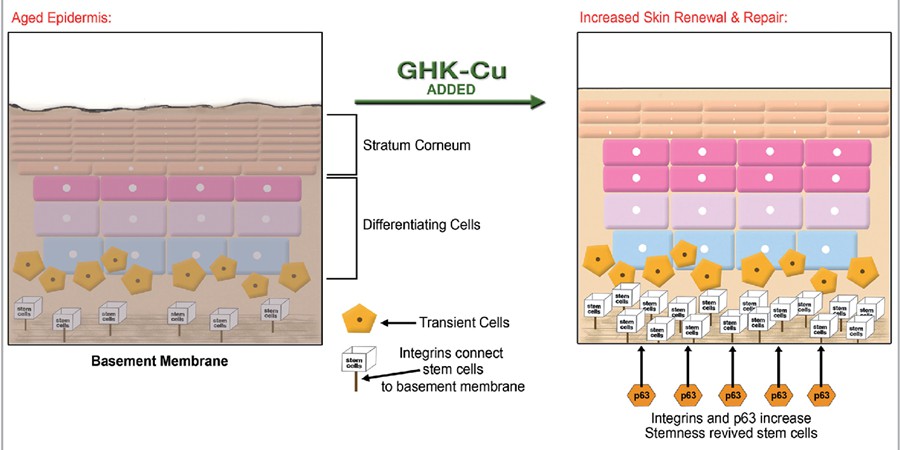
Skin regeneration depends on the viability and proliferation of skin stem cells. Skin hyperplasia begins at the base with keratinocytes attached to the basement membrane. Terminal differentiation begins when cells leave the basement membrane. Stem cells have an unlimited capacity for self-renewal, yet their potential proliferative declines with age. And GHK-Cu can help promote the regeneration of skin stem cells.
4) Promoting the repair of damaged DNA
Fibroblasts are the primary cells in wound healing and tissue regeneration. They synthesize various components of the extracellular matrix and produce many growth factors (these factors regulate cell migration and proliferation, angiogenesis, epithelialization, etc.). Radiation damages the DNA of cells, which in turn impairs cell function.
The researchers used fibroblasts from necks exposed to radiation and added GHK to a serum-free medium, while the control group did not add GHK. Although the cells in the control group could survive and reproduce, their growth curves were utterly different from normal cells. The growth of irradiated cells was delayed compared with normal cells in the 24h and 48h assays. In contrast, irradiated cells treated with GHK grew faster (behaved similarly to normal cells). In addition, GHK-treated cells produced more critical growth factors for wound healing.
Since GHK can restore the function of irradiated cells, it is reasonable to believe that GHK can repair damaged DNA.

As a professional GHK-Cu powder manufacturer, Xi'an Sonwu can supply high-quality powder at a competitive price. If you need it, don't hesitate to contact Xi'an Sonwu.
Email ID: sales@sonwu.com