




Why everyday behaviors lead to frequent fractures in older adults: The hidden culprit isn't just calcium deficiency.
The narrative about fractures in older adults needs to shift from "they just fell" to "Why do their bones break so easily?" The answer often lies in bone quality, not just bone quantity.
When we think of fractures in older adults, we often picture a nasty tumble on an icy sidewalk. However, growing medical evidence suggests a more nuanced culprit: the cumulative effects of subtle, everyday stresses on fragile bones. Experts are now calling this a silent epidemic of "fragility fractures," which often begin with simple actions like lifting a shopping bag or getting out of the bathtub. Meanwhile, for many older adults, a simple slip on a carpet, a sudden sneeze, or even simply making the bed can lead to a life-altering fracture. Fractures are often dismissed as "just a fall," but in reality, the fracture itself may already be fragile and susceptible to breaking at the slightest stress.

Osteoporosis, a common skeletal disease, literally means "porous bone." It's been nicknamed a "silent epidemic" because it develops slowly and often without noticeable symptoms until a fracture occurs. Think of your bones as the supporting structure of a house. Healthy bones have a dense, strong meshwork inside, like fine hardwood.
In osteoporosis, however, these microscopic structures gradually break down, resulting in a reduction of bone mass and density. This leads to porous bones, making them more like brittle chalk or sponges. This structural deterioration makes bones so fragile that even a minor bump, fall, sneeze, or bending over to tie your shoe can cause a fracture.

We're not just talking about major trauma. For people with osteoporosis, bone density is so low that a slight twist, a sudden twitch, or even a violent cough can be enough to cause a vertebral compression fracture or a broken wrist. Bones shatter under the pressure they are supposed to withstand. Osteoporosis, a disease that causes bones to become weak and brittle, affects millions of people worldwide. However, its danger lies in its silent nature-it often goes undiagnosed until a fracture occurs.
Here are doctors' lists of seemingly dangerous everyday activities:
1. Twisting is the number one culprit. Combining your toes while sitting, reaching for a seatbelt while in a fixed position, or lifting a pet from the ground without turning can put tremendous stress on the spine.
2. Reaching to grab a heavy dish from a cupboard or pulling a suitcase from a luggage rack can lead to spinal, wrist, or shoulder fractures.
3. While exercise is crucial, suddenly stretching after waking up can cause microfractures in fragile vertebrae.
4. Getting in and out of a deep couch, a low car seat, or a bathtub requires strong core strength. Without core strength, the force is transferred to the spine.
5. A violent sneeze, catching yourself after a near fall, or even trying to lift a full water bottle, can be the straw that breaks the camel's back.
These actions can lead to falls and unstable footing in older adults with osteoporosis, and severe falls can lead to a variety of health problems.
The good news is that this crisis is largely preventable.
For decades, the public health message has been clear: calcium and vitamin D are essential for bone health. While this is true, it's only half the story. Consuming calcium is one thing; ensuring your body can use it properly is another. Calcium metabolism is a complex process. Simply put, you need "traffic controllers" to guide calcium to the right destinations (bones and teeth) and away from the wrong ones (blood vessels and soft tissues). Without these "traffic controllers," calcium can lead to a dual problem: osteoporosis and cardiovascular issues. The body produces specific proteins to manage calcium, such as osteocalcin for bones and matrix protein glutamate for arteries. (MGP). However, these proteins are naturally inactive. They need to be "activated," or "carboxylated," to function effectively. This activation is impossible without a key coenzyme. Therefore, it's essential to supplement your calcium intake with vitamins to "direct" the calcium's direction.
But with so many vitamins with different letters and numbers, how do you know which ones are truly essential for bone health and which are just marketing gimmicks? How can you choose the right vitamins for your bones?
Experts say the answer lies not in chasing the latest trends but in understanding proven, synergistic nutrients that can build and protect bone density. If vitamin D3 helps calcium enter the bloodstream, vitamin K2 directs it to its proper destination. Vitamin K2 activates proteins that act like traffic cops, transporting calcium to bones and teeth and away from potentially damaging arteries. In other words, without vitamin K2, calcium may not be properly incorporated into the bone matrix. There are many forms, but MK-4 is particularly noteworthy. Found primarily in animal products like egg yolks, dairy, and liver, it's the form the body is pre-programmed to most effectively activate calcium management proteins. Its unique structure allows for rapid absorption and targeted action in critical tissues, such as bones and arteries.
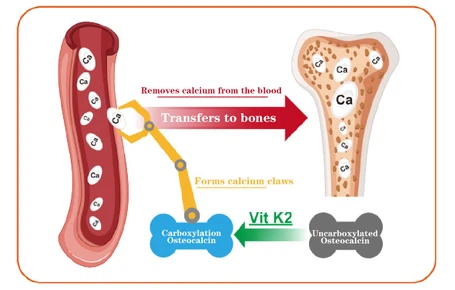
Modern diets are often deficient in vitamin K2-MK4. This deficiency worsens with age, as the body's ability to manage the mineral declines.
For years, attention has focused on calcium intake, but science now shows that without the activation of vitamin K2-MK4, calcium may not provide the bone strength we desire. The key is to ensure the nutrients you consume are functioning as intended. Supplementing with vitamin K2-MK4 can significantly improve bone strength and density, effectively alleviating the challenges faced by those with osteoporosis. By strengthening the collagen matrix within bones, elderly individuals can reduce fracture rates, preventing the inadvertent effects of daily life. It also supports vascular elasticity by inhibiting harmful calcification. This allows older adults to lead active and independent lives without worrying that small, everyday movements could lead to serious problems, thereby reducing the challenges faced by adults.
Vitamin K2-MK4 powder is an essential, fat-soluble vitamin that is crucial for human health, particularly bone and cardiovascular health. It primarily works by binding to vitamin K-dependent proteins in the body. The activity of these proteins requires carbonylation in the blood vessel walls to maintain bone strength and cardiovascular health. Therefore, taking vitamin K2-MK4 can significantly increase bone density and reduce the risk of fractures, especially for the elderly and those with osteoporosis.