


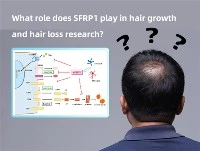



Hair loss research has gradually moved beyond traditional approaches that focused solely on hormones, inflammation, or blood circulation. Scientists are now paying more attention to the molecular signals that control the entry, maintenance, and exit of hair follicles from active growth phases. Among these pathways, the interaction between SFRP1 and the Wnt/β-catenin signaling pathway is particularly noteworthy.
SFRP1, secreted curl-associated protein 1, is a naturally occurring protein that regulates the Wnt signaling pathway. Because Wnt/β-catenin activity plays a crucial role in hair follicle development and growth, researchers have been investigating whether changes in SFRP1 activity affect the hair growth cycle.

Why is SFRP1 so important in hair follicle biology?
To understand SFRP1's potential significance, it helps first to understand the Wnt/β-catenin signaling pathway.
The Wnt signaling pathway is an important biological communication system involved in cell development, tissue maintenance, and regeneration. In hair follicles, the classic Wnt/β-catenin signaling pathway is associated with the activity of various cell populations involved in hair generation. Changes in this pathway affect hair follicle development and the transitions between different stages of the hair growth cycle.
SFRP1 belongs to a class of secretory proteins that regulate the Wnt signaling pathway. SFRP1 not only functions as an independent growth factor; it can also interact with Wnt ligands, reducing their ability to activate downstream signals.

This creates a molecular balance. When Wnt signaling pathway activity is properly regulated, hair follicle cells can receive the signals needed for normal growth and differentiation. When this balance is disrupted, hair follicle behavior changes. Researchers studying human scalp hair follicles found that SFRP1 is expressed in the dermal papilla and can affect the activity of the Wnt/β-catenin signaling pathway within the hair follicle. WAY-316606, a selective SFRP1 antagonist, is a promising research compound for investigating the relationship between SFRP1 activity and hair follicle growth. In an in vitro study of human scalp hair follicles, researchers found that inhibiting SFRP1 with WAY-316606 increased markers associated with the classic Wnt/β-catenin signaling pathway and promoted hair shaft formation. These findings provide a useful experimental model for studying how SFRP1 regulation affects the hair growth cycle. Importantly, these observations were drawn from laboratory-cultured human hair follicles and should not be interpreted as evidence that WAY-316606 has been approved to treat hair loss.
Experiments showed that increased SFRP1 levels reduced the activity of Wnt-related target genes, while pharmacological inhibition of SFRP1 increased markers associated with the classical Wnt signaling pathway.
This is crucial because the dermal papilla is a key signaling center within the hair follicle. Communication between dermal papilla cells and surrounding epithelial cells helps coordinate hair shaft formation and follicle activity.
In short, SFRP1 can be considered one of the molecular "brakes" controlling the Wnt signaling pathway. Understanding how this "brake" works can provide researchers with another way to study hair growth mechanisms.

What does SFRP1 research tell us about hair growth?
One of the most compelling findings comes from experiments using cultured human scalp hair follicles. Researchers observed that inhibiting SFRP1 activity enhanced the classical Wnt/β-catenin signaling pathway and promoted hair shaft generation in an experimental model. This therapy also increased the expression of hair shaft keratin K85 and reduced the tendency of hair follicles to enter the catagen phase (also known as the regression phase).
The study used a specific SFRP1 antagonist, WAY-316606, as a pharmacological tool to investigate SFRP1 function. After treatment, researchers observed increased expression of Wnt-responsive markers (such as AXIN2 and LEF1) in cultured human hair follicles, followed by enhanced hair shaft elongation.
Importantly, these results come from in vitro human hair follicle experiments, not completed clinical trials demonstrating efficacy in patients with hair loss. This distinction is crucial when interpreting early hair growth studies. Nevertheless, this research still helps establish a useful scientific concept: researchers may be able to influence the Wnt signaling pathway by altering one of its natural regulatory mechanisms, rather than activating it unquestioningly.
Could SFRP1 become a key target for future hair loss research?
The growing interest in SFRP1 reflects a shift in hair biology research toward the molecular regulation of the hair growth cycle. Traditional hair loss research typically focuses on reducing hormonal effects or stimulating hair follicle growth through established mechanisms. Molecular research is expanding this field and raising a different question: which signals promote sustained hair follicle growth, and which cause it to cease? SFRP1 is closely related, as it sits within the Wnt signaling pathway regulatory network. Experimental evidence suggests that reducing SFRP1 activity can enhance the Wnt/β-catenin signaling pathway in human hair follicles and promote hair shaft generation under laboratory conditions. However, many challenges remain before this research can be translated into practical human applications. Laboratory results cannot directly predict clinical efficacy. Researchers still need to understand factors such as long-term safety, appropriate administration methods, tissue selectivity, dosage, pharmacological behavior, and differences between experimentally induced and naturally induced hair loss follicles.

Another important consideration is that different types of hair loss have different biological etiologies. Androgenetic alopecia, alopecia areata, telogen effluvium, cicatricial alopecia, and other conditions involve different mechanisms. A pathway that appears promising under one experimental condition may not be equally applicable in all cases.
Therefore, for research institutions, cosmetic ingredient developers, drug developers, and laboratories studying hair follicle biology, SFRP1 represents a research target, not a proven clinical solution. Its relationship with the Wnt/β-catenin signaling pathway offers an opportunity to explore new mechanisms of hair follicle regulation and identify potential future drug candidates.
As research progresses, the most valuable advances may come from understanding how SFRP1 interacts with other signaling molecules, rather than treating it as an isolated target. The relationships between SFRP1, DKK1, Wnt ligands, β-catenin, dermal papillary cells, and hair follicle stem cell activity may contribute to a more comprehensive understanding of the regulatory mechanisms of the hair growth cycle.
For research teams studying SFRP1, the Wnt signaling pathway, and hair follicle biology, obtaining well-defined research materials is crucial to experimental development. When evaluating WAY-316606, researchers should consider factors such as identification, purity, analytical documentation, storage conditions, and batch consistency, and select research-grade materials.